
5 min readDaoChemist
What Is an Agent Trust Profile?
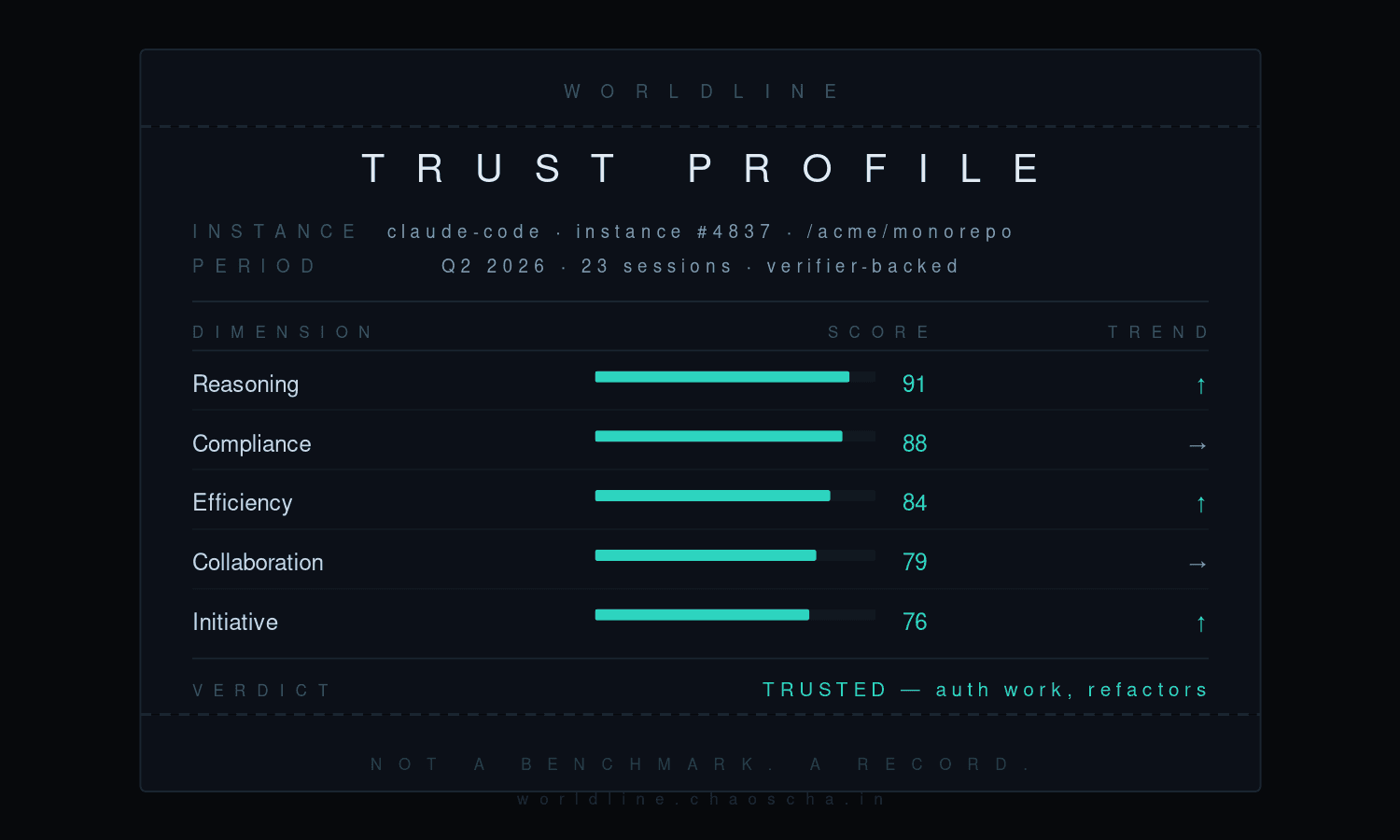
The phrase "agent trust profile" is starting to appear in engineering conversations. In procurement decks. In post-incident reviews. Usually without a definition.
That is a problem, because a term without a definition is a term anyone can fill. And in the coding agent market, the filling happens fast: a benchmark rank gets called a trust profile. A session score gets called a trust profile. A vendor's confidence meter gets called a trust profile. None of these are the same thing, and treating them as if they are produces the exact failure the phrase is supposed to prevent.
So: a precise definition, once, from the people building the infrastructure to produce one.
An agent trust profile is a per-instance, accumulated, verifier-backed record of what a specific agent did on a specific body of work, scored across five dimensions, that makes the next routing decision traceable:
Per-instance. Not per-model. Not per-vendor. The same underlying model behaves differently depending on the codebase it is working in, the harness it is running through, and the history of how it has been used in this repository. A trust profile belongs to the instance, ie the specific deployment of that model, in your environment, on your tasks. The model name tells you nothing that the instance record does not correct.
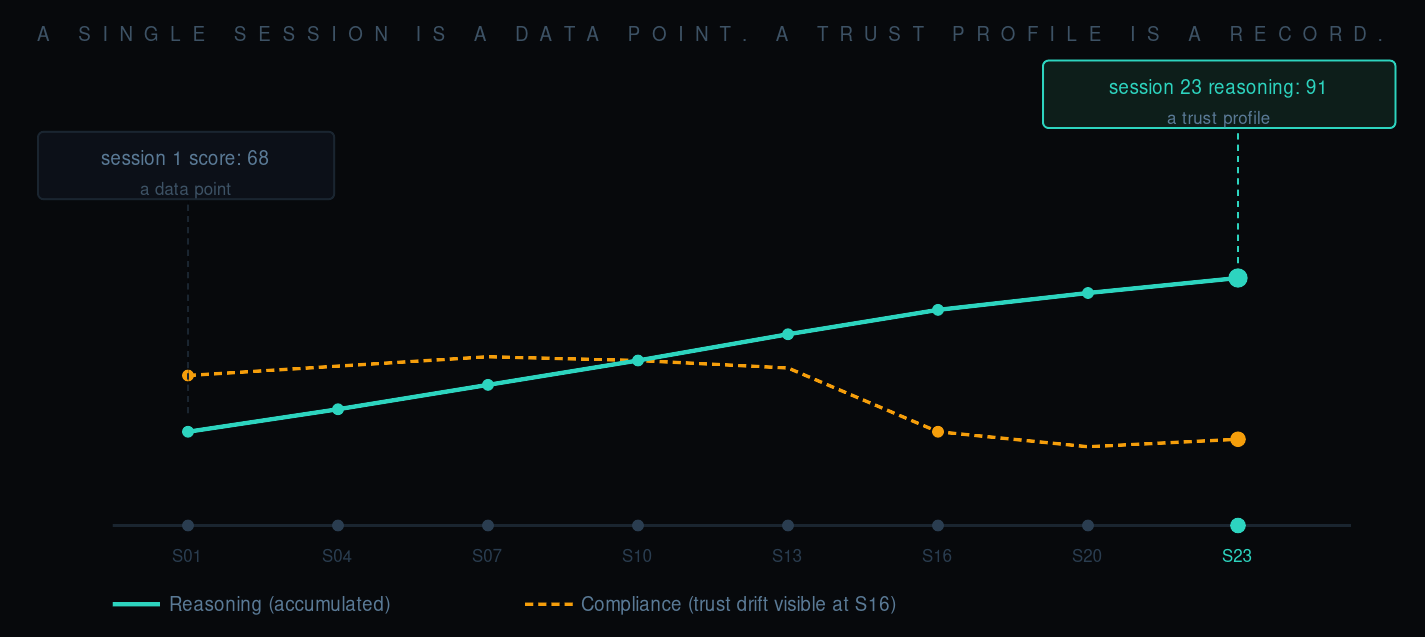
Accumulated. A trust profile is not a single session score. A single session is a data point. A trust profile is what ten sessions, twenty sessions, a quarter of production work looks like when the scoring is consistent and the trace is captured each time. Trust is not a property of one run. It is a property of a record.
Verifier-backed. The score that goes into the profile is not self-reported by the agent. It is produced by an independent verifier that reads the session trace, ie the full sequence of actions, tool calls, and decisions, and evaluates what actually happened. The agent's narrative of what it did is not the input. The trace is the input.
Five dimensions. Trust in an agent is not one number. It is a structured judgment across five distinct properties of the work:
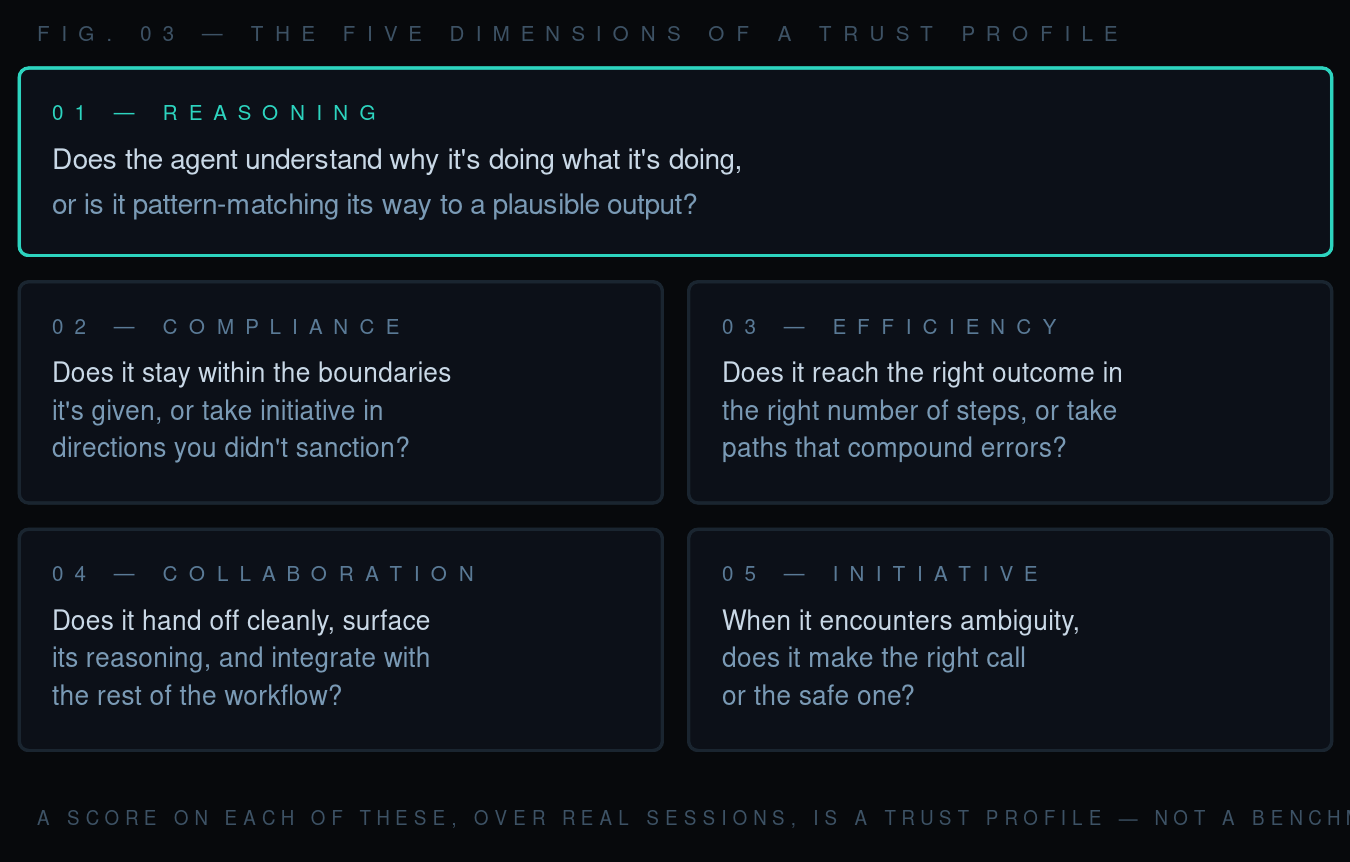
A single aggregate score collapses these into one number and loses all of the information that makes the score actionable. Knowing an agent scored 84 tells you to trust it. Knowing it scored 91 on reasoning and 61 on compliance tells you exactly which kind of work to give it next -- and which to route elsewhere.
Traceable. The profile does not exist to produce a verdict. It exists to make the next decision auditable. When you route a task to an agent based on its trust profile, you should be able to show, after the fact, what evidence produced that routing choice. That is the difference between a decision system and a dashboard.
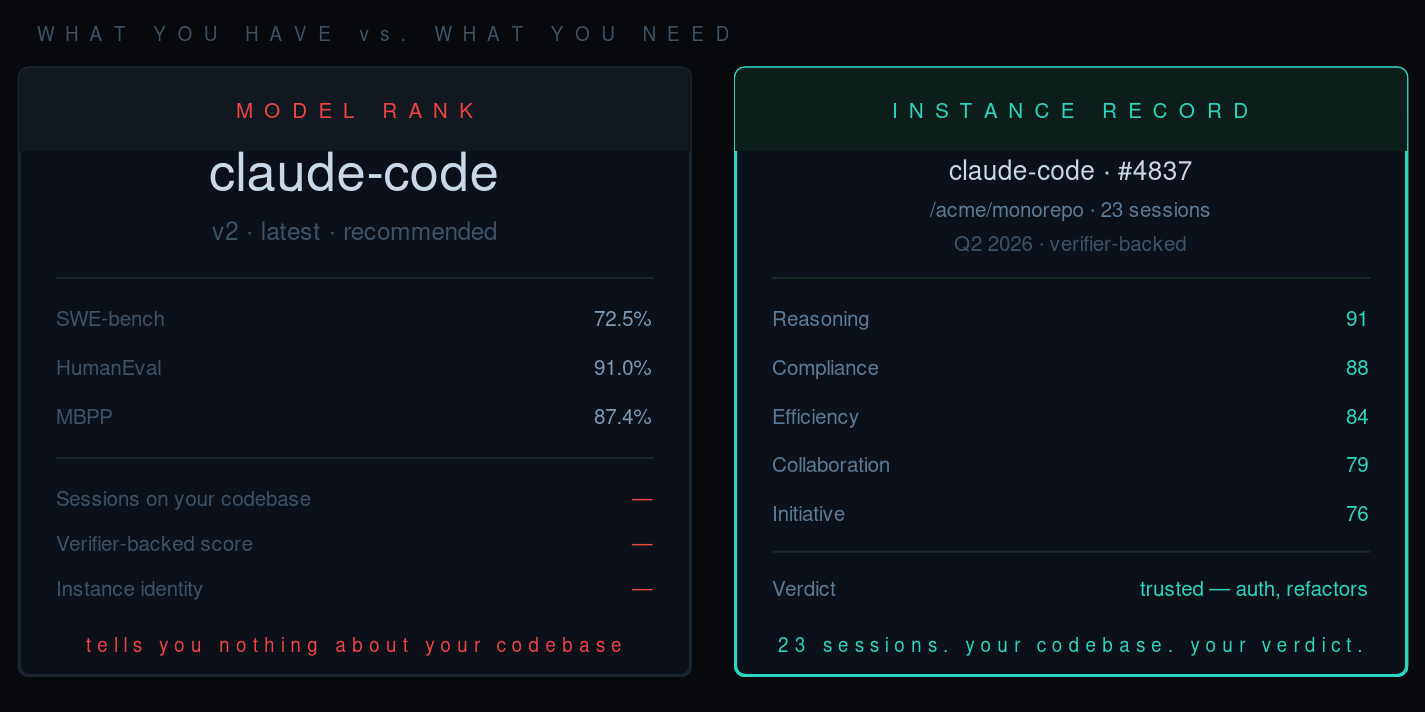
A benchmark rank is not a trust profile. Benchmarks measure a model's performance on a standardized test suite. A trust profile measures an instance's performance on your actual work. These are different instruments measuring different things. A benchmark rank is useful for model selection. A trust profile is what you need once the model is running and the question is which instance has earned the right to take the next task.
A single session score is not a trust profile. One session is a data point. It tells you something about that run. It tells you very little about what the agent will do on the next one.
A confidence meter is not a trust profile. Confidence meters are self-reported by the system producing the output. They measure the system's internal uncertainty, not the verifier's external judgment of what the system actually did. Self-reported confidence is a claim. A trust profile is evidence.
A model-level reputation is not a trust profile. Claude Code in your fintech monorepo with six months of session history is not the same agent as Claude Code in a fresh greenfield repo running for the first time. Instance identity is the unit. Model brand is noise.
Without a trust profile, routing is by feel. Teams develop informal reputations for agents, ie "we use X for refactors, Y for greenfield," backed by whoever spoke loudest in the last post-incident review, not by session evidence.
The more insidious failure is trust drift: the slow degradation of an agent's performance on a codebase that does not announce itself. The agent that earned trust on Q1 work may be failing on Q3 work, because the codebase has shifted and no one kept the record. Without a trust profile, trust drift is invisible until it has caused damage.
Without a trust profile, accountability is a diff. The post-incident record contains the artifact, ie the code change, but not the evidence: the trace that shows what the agent did and why the verifier would or would not have flagged it. The diff is what the agent produced. The receipt is what it did.
Run two agents on the same task, captures both session traces, and scores each one across all five dimensions with an independent verifier in the loop. When it finishes, you hold something your team has not held before: a session-level trust profile, per-instance, verifier-backed, five dimensions, with the trace attached. The first data point in a record that will make every routing decision after it traceable.
Pull the receipt at worldline.chaoscha.in.
Profile the agent. Measure the work. Trust the verdict. A trust profile is the record the verdict lives in, not the score alone, but the trace that produced it, the five dimensions that structured it, and the instance history that makes it mean something over time.
The trust gap is not theoretical: you are already deciding which agent to trust on which work. You are doing it by feel. The question is whether you can see it.
Start with Worldline: Two agents, same task. The verifier scores each one across five dimensions: reasoning, compliance, efficiency, collaboration, initiative. You finish with the first session-level trust profile your team has ever held, in a few minutes of real work, on your codebase.
The market has already begun sorting engineering teams into two groups. The ones who can name, per agent, on what work, with what evidence, which instance earned the right to ship. And the ones who cannot. Worldline is where the first group keeps the record. macOS beta, Apple Silicon and Intel. worldline.chaoscha.in.
Cross-posting note
When this article is syndicated to Medium, use https://chaoscha.in/blog/what-is-an-agent-trust-profile as the canonical URL.